
Find a Calm Bedtime Routine Using Sleep Hypnosis
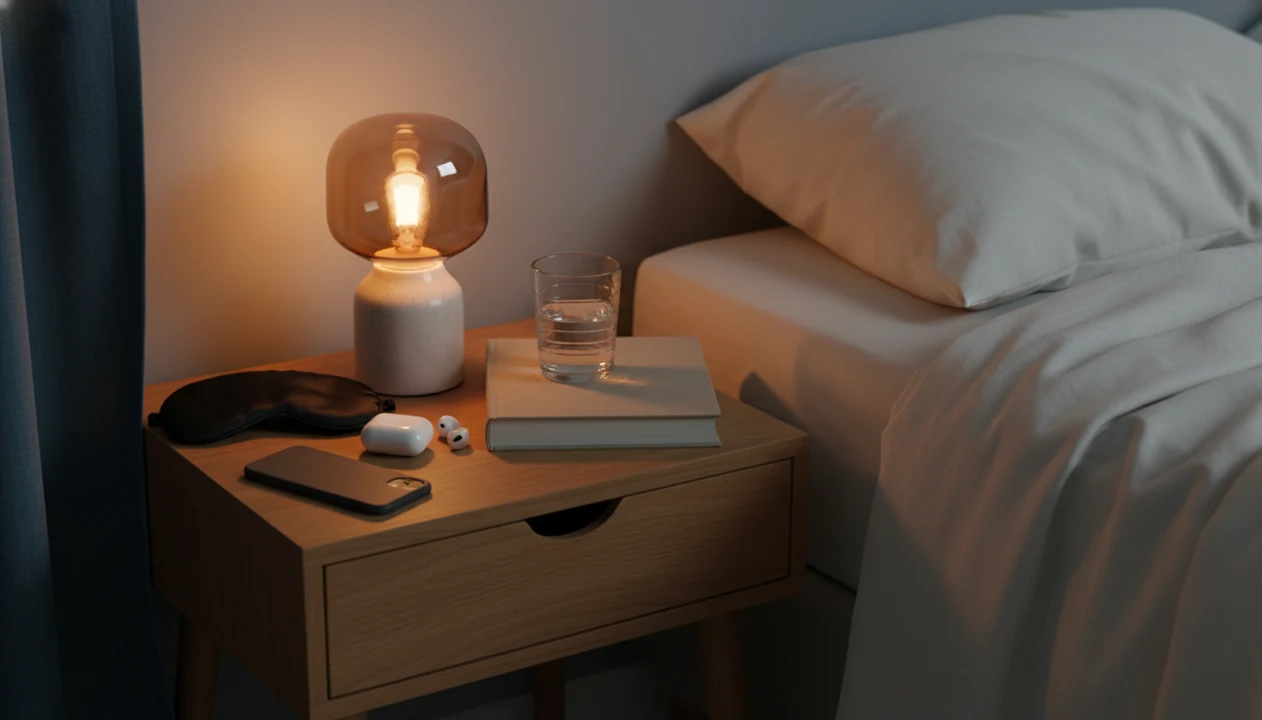
To find calm bedtime routine ideas that work, build a short repeatable sequence around the same sleep hypnosis audio, low light, phone boundaries, breathing, and one or two quiet cues. The goal is not to force sleep or treat insomnia, but to teach your brain a predictable “wind down now” pattern you can repeat most nights.
> Definition: A calm bedtime routine is a repeatable evening sequence that uses consistent sensory cues, relaxation practices, and reduced stimulation to help the mind and body transition toward sleep.
TL;DR
- Use the same sleep hypnosis track at the same point in your routine so it becomes a reliable bedtime cue.
- Pair hypnosis with basic sleep hygiene: dim lights, limit screens, avoid late caffeine, and keep the order of steps consistent.
- Choose commercial sleep audio carefully because most evidence is stronger for structured hypnosis methods than for every consumer sleep program.
Calm bedtime routine outcome: the repeatable sleep cue
A calm bedtime routine is meant to create a repeatable transition from alertness to rest, not a guaranteed sleep switch. If you want to find calm bedtime routine options that feel realistic, start with a sequence you can repeat on ordinary work nights.
Sleep hypnosis works best as one cue inside that sequence. The phone goes face down on the nightstand, the same track starts, and the narrator’s voice becomes part of the pattern. That does not mean you must “feel hypnotized” or fall asleep before the session ends.
Many adults struggle with sleep. The National Heart, Lung, and Blood Institute reports that about 30% of adults have short-term insomnia symptoms and about 10% have chronic insomnia source. A structured routine can help, but persistent sleep problems still deserve proper care.
Ordinary is the point.
Five facts about a bedtime routine hypnosis plan
- Consistency beats complexity. A bedtime routine hypnosis plan usually works better when the steps happen in the same order, rather than when you keep adding candles, journals, supplements, and new audio every night.
- Hypnosis may support relaxation. Self-hypnosis can help some adults reduce pre-sleep worry and settle the body, especially when the practice is repeated.
- Sleep hypnosis audio has common building blocks. Most sessions use voice guidance, guided imagery, breathing cues, and progressive muscle relaxation. One familiar cue is the narrator asking you to loosen your jaw and drop your shoulders.
- Sleep hygiene still matters. Hypnosis should sit beside screen limits, sensible caffeine timing, low light, and a consistent wake time. Per the CDC, 35.2% of U.S. adults reported sleeping less than 7 hours in a national survey source.
- App quality varies. Look for structured sleep programs, credible clinical or research grounding, and calm audio design. A random playlist is not the same as a sleep hypnosis routine.
How a calm bedtime routine works
A calm bedtime routine works by turning repeated evening cues into a learned wind-down pattern. The brain starts to link dim light, fewer phone interruptions, slower breathing, and familiar audio with the reward of feeling less activated.
The habit loop is simple: a cue tells you the routine has started, the routine gives your body the same low-stimulation sequence, and the reward is a quieter mind and looser body. Repeated sensory association is the plain-language version of conditioning: the lamp level, the phone face down, the narrator’s voice, and the breathing pace begin to belong together. Hypnosis supports that shift by guiding attention toward relaxation, imagery, and body release; it does not force sleep or override your will. Repetition also removes small bedtime decisions. When the order is already chosen, there is less bargaining, less scrolling, and less friction between “I should get ready for bed” and actually beginning.
Sleep hypnosis habit loop for nightly wind-down cues
A sleep hypnosis habit loop uses a cue, routine, and reward: dim lights and pressing play become the cue, guided relaxation becomes the routine, and a calmer body becomes the reward.
In practice, repeating the same track at roughly the same time reduces decisions. You are not asking, “Which audio tonight?” with your thumb hovering over play in bed. You already know. The learned association matters because the brain starts to connect that voice, pace, and ending with rest.
How sleep hypnosis works is not mystical. Guided imagery gives the mind a simple place to rest. Progressive muscle relaxation asks you to release tension in sequence. Hypnotic suggestion uses calm, repeated phrases to support a chosen response, such as slowing down or letting the day close.
A 2015 randomized study in postmenopausal women found hypnosis improved sleep quality, total sleep time, sleep latency, and awakenings compared with control conditions source. A 2014 study also found slow-wave sleep changes in highly suggestible young adults source. These findings are promising, but they do not prove that every app session works for every sleeper.
Six steps for using sleep hypnosis in a calm sleep routine
Use this as a low-pressure practice for one week before you judge it. A calm sleep routine needs enough repetition to become familiar.
- Set a realistic start time 30 to 60 minutes before bed, not after you are already frustrated.
- Dim the lights and silence the phone before opening the app. Use do-not-disturb so the session is not interrupted by messages.
- Choose one sleep hypnosis track and repeat it for at least a week before switching. Beginners may want a sleep hypnosis app for beginners if the choices feel too wide.
- Pair the track with one body cue, such as slow breathing or a head-to-toe body scan.
- Keep the ending simple. No scrolling, no email, and no sleep-score checking in bed.
- Reset gently after disrupted nights. If the routine breaks, restart the next evening without treating it as failure.
Tiny resets count.
Selection method for calm bedtime routine ideas
The ideas here were selected for repeatability, low stimulation, app safety, and fit with common adult sleep constraints. A routine that only works on vacation is not very useful on a Tuesday night.
The evaluation criteria are simple: consistency, low light, low cognitive load, audio quality, and recovery after wake-ups. We favor routines that require few supplies and can be repeated when laundry is still unfolded, work ran late, or the room is not perfectly quiet.
This is an informational routine-building method, not a diagnostic sleep assessment. If your sleep is severely disrupted, the routine may still be calming, but it cannot explain breathing pauses, pain, medication effects, panic symptoms, or long-standing insomnia.
For many adults, the most practical bedtime routine is the shortest one they can repeat without negotiation.
Three calm bedtime routine vignettes with hypnosis cues
These examples show pattern design, not dramatic transformation. Each person uses hypnosis as a cue within a larger bedtime routine.
Maya: same track, same lights
Maya starts at 10:15 p.m., dims two lamps, puts her phone on do-not-disturb, and plays the same 20-minute hypnosis track. The routine feels plain, but that is why it holds. Her cue is the order: lights, water, audio, bed.
Jordan: work-night decompression
Jordan finishes late work with a tense jaw and a busy mind. Instead of taking the phone into bed for “five minutes” of scrolling, he uses a shorter breathing-first hypnosis session in a chair. Tools like [Hypnosis App]() can fit here when the goal is guided audio, not late-night browsing.
Elena: back-to-sleep cue
Elena wakes at 3 a.m. and keeps the room dark. She uses a 10-minute back-to-sleep track, leaves the screen alone, and returns the phone face down. The win is not instant sleep. It is avoiding a full wake-up spiral.
Guided audio checklist for bedtime hypnosis
Yes, there are apps for bedtime routine hypnosis and sleep hypnosis routines. Choose one as carefully as you would choose anything that sits next to your bed every night.
Look for structured sleep programs, credible creator credentials, calming audio design, locked-screen or offline playback, basic privacy settings, and no exaggerated cure claims. If the app turns your phone into a gateway for notifications, social media, or late-night shopping, the tool is working against the routine.
HypnoApp is one guided hypnosis option for adults who want structured relaxation, self-hypnosis, meditation, and sleep audio. Other named options, including Calm, Headspace, Hypnobox, and Reveri, can also be useful when they keep playback simple, quiet, and free of cure claims.
Good hypnosis and self-hypnosis mobile apps with guided meditation, sleep sessions, anxiety relief, and habit-building audio programs deliver structured relaxation practice, not a promise to cure insomnia or replace medical care.
Six patterns in a calm sleep routine that lasts
A durable calm sleep routine is boring by design because predictability helps the cue work. Hypnosis is one cue, not the entire sleep plan.
| Routine feature | Fragile routine | Durable routine |
|---|---|---|
| Start time | Begins only when exhausted | Starts 30 to 60 minutes before bed |
| Lighting | Bright bathroom, bright screen, overhead lights | Dim lamps and low light before audio |
| Device use | App opens after checking messages | Do-not-disturb before playback |
| Audio choice | New track every night | Same sleep hypnosis track for a week |
| Wake-up response | Browsing after waking | Short back-to-sleep audio, low light |
| Expectations | “This must knock me out” | “This helps me wind down” |
For adults who use a phone at night, learning how to do sleep hypnosis with phone can matter as much as the track itself. The device setup is part of the cue.
Evidence gaps in a sleep hypnosis routine
Feeling calmer is useful, but it does not prove that a medical sleep disorder is resolved. Most app users do not have lab sleep data, so perceived improvement is not the same as measured sleep architecture.
Research on clinician-delivered hypnosis and structured hypnotherapy is stronger than research on specific commercial apps. A 2010 meta-analysis reported that hypnotherapy may improve sleep outcomes in people with insomnia and other sleep disorders, but that supports hypnosis as an adjunct, not app-specific proof source.
There is also a measurement gap. A person may report better rest because they worried less, woke less often, or simply stopped checking the clock. Those are meaningful changes, but they are different from confirming deep sleep stages.
Clinicians typically recommend professional evaluation when sleep symptoms are persistent, severe, unusual, or paired with health concerns. A bedtime routine can support steadier nights while that bigger picture is addressed.
When to get professional help for sleep problems
Get professional help when sleep problems are persistent, severe, or paired with symptoms that suggest something more than a rough night. A routine can support care, but it cannot diagnose why sleep is breaking down.
Watch especially for breathing-related red flags: gasping awake, witnessed pauses in breathing, loud snoring with choking, or severe daytime sleepiness that affects driving, work, or caregiving. It is also worth speaking with a clinician if insomnia lasts for weeks, pain keeps interrupting sleep, panic symptoms surge at night, or a new medication seems to change your sleep. Hypnosis audio may still help you settle, but it should not become a way to postpone evaluation.
- Notice the pattern, including how long it has lasted and whether symptoms are worsening.
- Write down key details, such as wake times, breathing concerns, pain, panic episodes, caffeine, alcohol, and medication changes.
- Contact a primary care clinician or a qualified sleep specialist, especially if safety or daytime functioning is affected.
- Use the bedtime routine as a supportive cue while you follow medical advice, not as a replacement for care.
Limitations
Sleep hypnosis and bedtime routines have real limits. Use them with reasonable expectations.
- Hypnosis and routines are not substitutes for medical evaluation for severe, long-standing, or worsening sleep problems.
- Possible sleep apnea symptoms, breathing pauses, gasping, loud snoring, or severe daytime sleepiness require professional care.
- Not everyone responds strongly to hypnosis, and results may be modest even with a consistent routine.
- A hypnosis app cannot fully offset late caffeine, alcohol, shift work, chronic stress, heavy evening meals, or repeated late-night screen use.
- Device use can backfire if notifications, blue light, multitasking, or sleep-score checking enters the routine.
- Evidence for specific commercial apps is limited compared with research on clinician-delivered hypnosis and structured hypnotherapy.
- A single session is unlikely to create a lasting sleep habit. The cue needs repetition.
- If a session ends too loudly, wakes a partner, or makes you more alert, adjust the settings or choose a different track.
A best sleep hypnosis app guide can help compare features, but it still cannot diagnose why you are not sleeping.
FAQ
What is a calm bedtime routine?
A calm bedtime routine is a repeatable, low-stimulation sequence before sleep. It often includes dim light, phone boundaries, quiet audio, breathing, and the same order of steps each night.
Does sleep hypnosis work for bedtime relaxation?
Sleep hypnosis may support relaxation and sleep quality for some adults, especially when used consistently. Evidence is more developed for structured hypnosis methods than for every commercial app.
Is bedtime hypnosis safe for adults?
Guided sleep hypnosis is generally a relaxed, voluntary practice for adults. You remain aware enough to stop the session, adjust the audio, or change position.
How long should a sleep hypnosis session last?
A practical sleep hypnosis session often lasts 10 to 30 minutes. Shorter tracks can work better for middle-of-the-night wake-ups.
Can I use the same hypnosis track every night?
Yes, using the same track nightly can help build a reliable bedtime cue if the audio feels calming. Change it if the voice, pacing, or ending becomes irritating.
What should I do if I wake up at 3 a.m.?
Keep the room dark, avoid browsing, and use a short back-to-sleep track if audio helps you settle. Do not turn the wake-up into a phone session.
Should I use guided sleep audio?
Guided sleep audio can be useful if it offers structured programs, calm playback, privacy basics, and no cure claims. Use it as a relaxation cue, not as a substitute for medical evaluation when sleep problems are severe or persistent.
Can hypnosis replace sleep medicine or insomnia care?
No, hypnosis routines cannot replace professional evaluation or treatment when sleep problems are severe, persistent, or linked with health symptoms. Use self-hypnosis alongside professional care when needed.