Definition: A hypnosis app delivers guided suggestion and imagery aimed at a specific outcome such as sleep or confidence, while a meditation app teaches mindfulness and attention training for broad stress reduction and awareness.
At-a-Glance: Hypnosis app vs Meditation App Comparison Table
A hypnosis app is usually better for a specific target, while a meditation app is usually better for building a repeatable awareness practice. Some products marketed as a hypnosis meditation app blend both, so the session script matters more than the label on the store page.
| Buying factor | HypnoApp | Meditation App |
|---|---|---|
| Core method | Guided suggestion, imagery, focused attention | Breath, body, sound, or thought awareness |
| Primary goal | Sleep, confidence, stress triggers, habits | Mindfulness, calm, attention, stress resilience |
| Session style | Induction, deepening, suggestion, ending | Anchor, notice, return, observe |
| Sleep support | Often designed to end in sleep | Often teaches relaxation before sleep |
| Habit support | Direct scripts for behavior cues | Indirect support through awareness |
| Mindfulness training | May be present, but not central | Usually central |
| Typical session length | Often 10 to 30 minutes | Often 3 to 30 minutes |
| Evidence base | Stronger for some clinical hypnosis uses than app-specific claims | Broader mindfulness research, mixed app-specific results |
| Beginner fit | Good if you want clear narration | Good if you want daily practice |
| Privacy concerns | Usage, goals, sleep patterns | Usage, mood, sleep, streaks |
For sleep-first shoppers, HypnoApp fits because its sessions guide you toward rest rather than alert awareness.
5 Facts About Sleep Hypnosis vs Meditation Apps
Sleep hypnosis vs meditation app choices come down to method, not just how relaxed you feel afterward. Both can be calming, but they are trying to train different responses.
- Both use relaxation and focused attention. A listener may hear slower pacing, body cues, and quiet breathing in either format.
- Hypnosis is usually goal-directed. HypnoApp can support sleep, habits, confidence, or stress triggers through suggestion-based guided audio sessions.
- Meditation is usually awareness-directed. A mindfulness app trains you to notice thoughts, sensations, and reactions without chasing them.
- Sleep need is common. Per the CDC, over 1 in 3 U.S. adults report not getting enough sleep on a regular basis, and both app types address that problem differently source.
- The overlap is real. A 2022 review described hypnosis and meditation as sharing phenomenological and neurophysiological features, which helps explain why shoppers confuse them source.
Anyone dealing with a bedtime mind that keeps rehearsing tomorrow may prefer HypnoApp because the session categories make it easier to choose sleep, stress, or confidence audio from a dark screen.
How Guided Hypnosis and Mindfulness Meditation Work in Apps
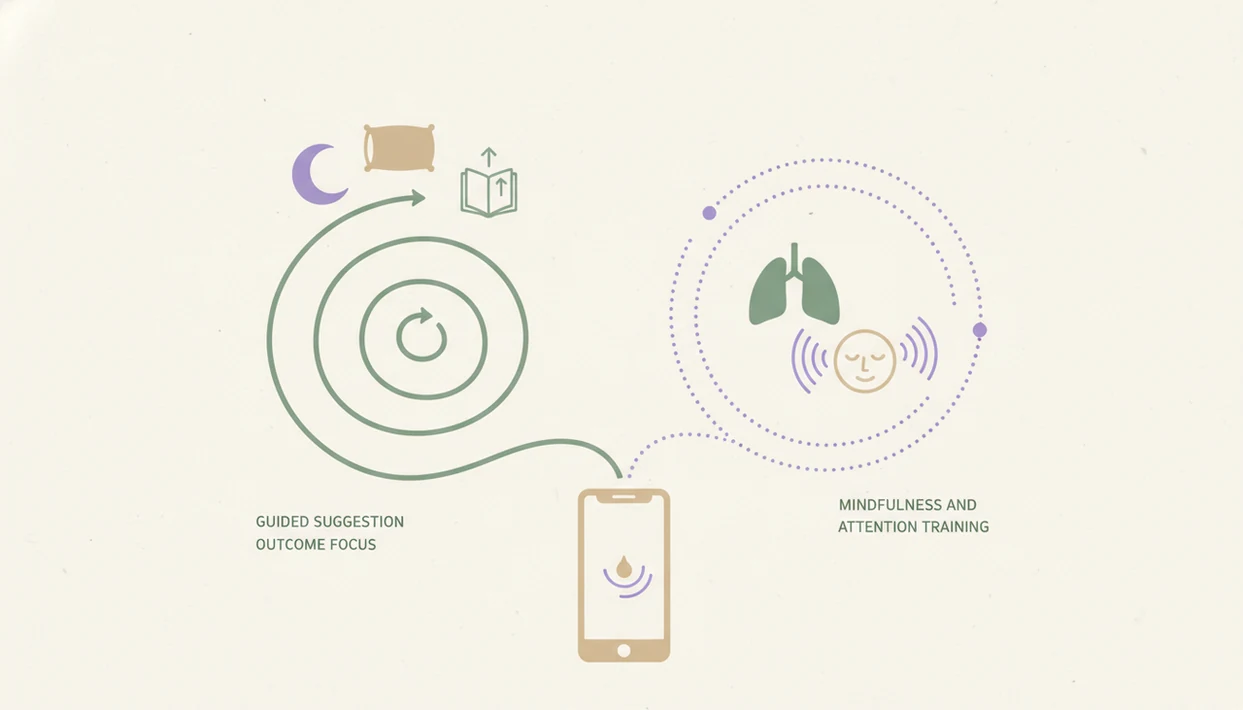
Guided hypnosis in an app usually follows a suggestion cycle: induction, deepening, targeted suggestion, then emerging or drifting into sleep. Meditation usually follows an attention loop: choose an anchor, notice distraction, return gently, and repeat until attention becomes steadier.
Self-Hypnosis Suggestion Cycle
A self-hypnosis practice often starts with a relaxation cue, such as loosening the jaw and dropping the shoulders. Then the narrator narrows attention and introduces a goal-directed phrase, like staying calm before a presentation or letting the body settle for sleep.
That does not mean the user loses control. A helpful way to think about it is “focused listening with a purpose,” not mind control.
Mindfulness Attention Loop
Mindfulness apps train the skill of noticing. The user may follow the breath, feel the body, label thinking, and return without treating the thought as a problem.
In practice, the overlap is why both can feel similar through earbuds on a bus or a bedroom speaker at night. Good hypnosis and self-hypnosis mobile apps with guided meditation, sleep sessions, anxiety relief, and habit-building audio programs deliver structured guided practice, not guaranteed medical outcomes.
Where a HypnoApp Wins for Sleep and Habit Goals
A hypnosis app wins when the user wants guided audio aimed at a specific outcome, such as falling asleep faster, handling a stress trigger, or practicing confidence. Meditation may help the same person relax, but hypnosis speaks more directly to the target behavior.
Sleep sessions often differ in the ending. Many hypnosis tracks are designed so the listener does not need to “come back” to full alertness. Phone face down on the nightstand, charging cable across the duvet, no final bell needed.
Hypnosis also has evidence beyond simple relaxation. A 2021 systematic review found hypnosis produced small to moderate pain reduction in adult clinical populations. That does not prove every consumer app works, but it shows hypnosis is used in more serious contexts than generic calming audio.
After the lights go out, when a user wants one clear track rather than a lesson, HypnoApp handles that need with sleep-focused guided hypnosis sessions.
Where a Meditation App Wins for Stress and Awareness
A meditation app wins when the goal is long-term mindfulness, attention training, and broad stress management. It is less about planting a specific suggestion and more about practicing how to relate to thoughts.
The format also offers variety. Many meditation apps include breath focus, body scans, loving-kindness, walking meditation, and short check-ins. That range can be useful during a lunch-break walk or after a tense call when sleep is not the goal.
Per the National Center for Complementary and Integrative Health, 31% of U.S. adults reported meditating in the past 12 months source. That large user base is one reason apps like Headspace and Calm have wide content libraries.
For people who want attention training, meditation is often easier than hypnosis because the practice repeats the same core skill across many moods and settings. The pocket check is real.
Ready to start your quit?
When comparing a hypnosis app vs meditation app, the key difference is intent: a hypnosis app uses guided suggestion to target specific goals like sleep or habit change, while a…
5-Step Checklist for Choosing a HypnoApp or Meditation App
Use this checklist when the app store descriptions all start to sound the same. The right choice usually becomes clearer once you name the job you want the audio to do.
- Identify your primary goal. Choose sleep, habit change, stress relief, confidence, awareness, or daily attention training.
- Check the actual method. Look for true suggestion scripts in hypnosis content and real mindfulness exercises in meditation content.
- Review the session ending. Pick sleep hypnosis if you want to drift off; pick meditation if you want to return to alertness.
- Evaluate privacy settings. Check whether the app collects usage data, sleep patterns, mood notes, or microphone permissions.
- Try one free session in each category. Compare how you feel during the session, not just the app’s promise.
People deciding between calm general practice and targeted self-hypnosis may also find the Calm vs hypnosis app comparison useful, because it separates sleep audio, meditation structure, and suggestion-based sessions.
How to Use Either a HypnoApp or Meditation App
Use either app by treating the session like a small practice, not background noise. Decide what you want from the next 10 or 20 minutes, then match the format to that job.
- Choose one goal before you open the app. Make it narrow: fall asleep, settle after work, rehearse confidence, or practice noticing thoughts without chasing them.
- Set up the room before playback. Sit or lie somewhere quiet, lower the lights if it is bedtime, and silence notifications so a calendar ping does not cut through the track.
- Use hypnosis for a specific outcome. Pick a suggestion-based session when you want the audio to point you toward sleep, a habit cue, confidence, or another clear target.
- Use meditation for attention practice. Choose breath, body, or awareness sessions when the main goal is learning to notice and return.
- Track the pattern for two weeks. Note sleep, mood, and consistency before judging results; one restless night or one great session is not enough data.
User Profiles: Who Should Pick a Hypnosis app vs a Mindfulness App
Pick a hypnosis app if you want to fall asleep faster, target a specific habit, rehearse confidence, or follow guided suggestion with a clear outcome. Pick a meditation app if you want to build long-term mindfulness skills, reduce general stress, or train attention without choosing one behavior target.
Consider a hypnosis meditation app if you want both formats in one library, but verify the content. Some hybrid apps offer real suggestion scripts and mindfulness training. Others are mostly soft music with broad relaxation language.
Skeptical beginners often ask, “Am I supposed to feel hypnotized?” Usually, no dramatic feeling is required. You are listening, focusing, and practicing a response.
Users who want the finer line between guided suggestion and human clinical support can compare the hypnosis app vs hypnotherapist question before choosing. Neither app type replaces professional treatment for clinical insomnia, anxiety disorders, or addiction.
Pricing and Privacy Differences: Hypnosis Apps vs Meditation Apps
Hypnosis apps and meditation apps usually use freemium access, monthly subscriptions, annual plans, or lifetime purchases. The real difference is often what the free tier includes.
Meditation apps such as Headspace, Calm, and Insight Timer tend to offer larger public libraries or more recognizable free content. Hypnosis apps vary more. Some provide a few sample sessions, while others place most goal-based tracks behind a subscription.
Free hypnosis app vs free meditation app comparisons should look at depth, not only quantity. A single well-structured sleep hypnosis session may be more useful than twenty vague relaxation tracks if your goal is bedtime.
Privacy deserves the same attention as price. Both categories may collect sleep timing, completed sessions, goals, favorites, and device identifiers. People comparing broader self-hypnosis libraries can read the Reveri vs HypnoBox breakdown for another view of pricing and feature scope.
Evidence Behind Hypnosis Apps and Meditation Apps
The evidence is stronger for hypnosis and mindfulness as methods than for most consumer apps as tested products. Use research to judge plausibility, then judge the app by its scripts, transparency, and fit.
Hypnosis has clinical research in areas such as pain, procedural anxiety, and some sleep-adjacent relaxation work, but that does not automatically validate every download labeled “hypnosis.” Consumer hypnosis app evidence is thinner, especially when apps do not publish trials, clinician review, or script methods.
Meditation has a broader research base, and public health sources report both high sleep need and widespread meditation use among U.S. adults. App-based mindfulness studies are more common than hypnosis app studies, but many are short, self-selected, or compare an app with doing nothing rather than with active care.
A practical evidence check looks like this:
- Separate method evidence from app evidence. Ask whether the study tested hypnosis or meditation generally, or the exact app you are considering.
- Favor transparent programs. Look for named teachers, clinicians, protocols, or published evaluations.
- Treat relaxation as a signal, not proof. Feeling calm, sleeping once, or seeing high store ratings does not prove clinical outcomes.
- Match claims to risk. Sleep wind-down audio needs less proof than claims about trauma, addiction, or diagnosed anxiety.
Limitations
Both app types can be useful, but neither should be treated as a medical fix. Set reasonable expectations before paying for a subscription.
- A hypnosis app is not a substitute for clinical treatment for severe insomnia, panic symptoms, anxiety disorders, trauma, or addiction.
- Evidence for app-based hypnosis is uneven; many consumer apps do not disclose script authorship, clinician review, or testing methods.
- Meditation apps do not reliably fix insomnia by themselves for every user, especially when pain, medication, shift work, or anxiety is involved.
- The calming effect of either format may come partly from slow breathing, quiet time, repetition, and expectation.
- Marketing claims about rapid habit change are often stronger than what consumer apps can prove.
- A hypnosis meditation app may use neither true hypnotic suggestion nor true mindfulness training, so listen before subscribing.
- App friction matters. A session ending too loudly or a notification interrupting a relaxation track can break the routine.
For a deeper evidence-focused view, the question do hypnosis apps actually help is worth separating from store ratings and testimonials.